
Activity
27-30/09/ 2026
HERAqua research presented at the 43rd ISE Topical Meeting in Gdańsk”
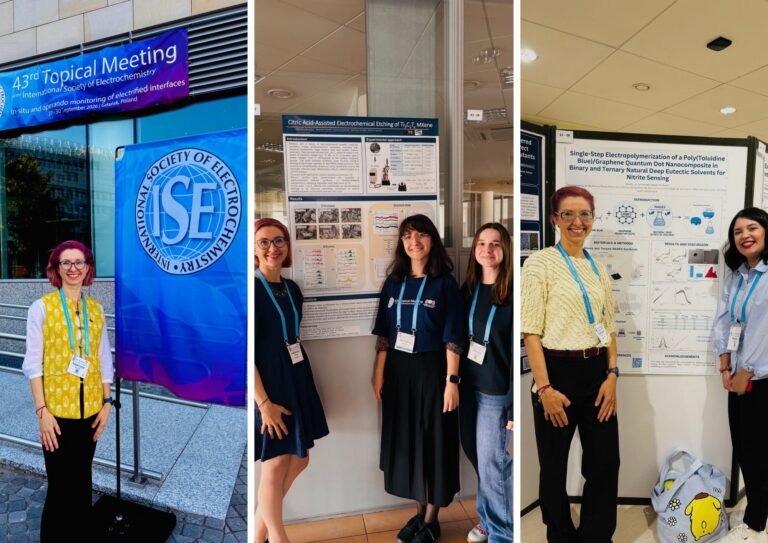
The HERAqua project was represented at the 43rd Topical Meeting of the International Society of Electrochemistry, held in Gdańsk, Poland, on 27–30 September 2026. The meeting, dedicated to In-situ and Operando Monitoring of Electrified Interfaces, brought together researchers working on electrochemical interfaces, functional materials, sensors and advanced characterisation methods.
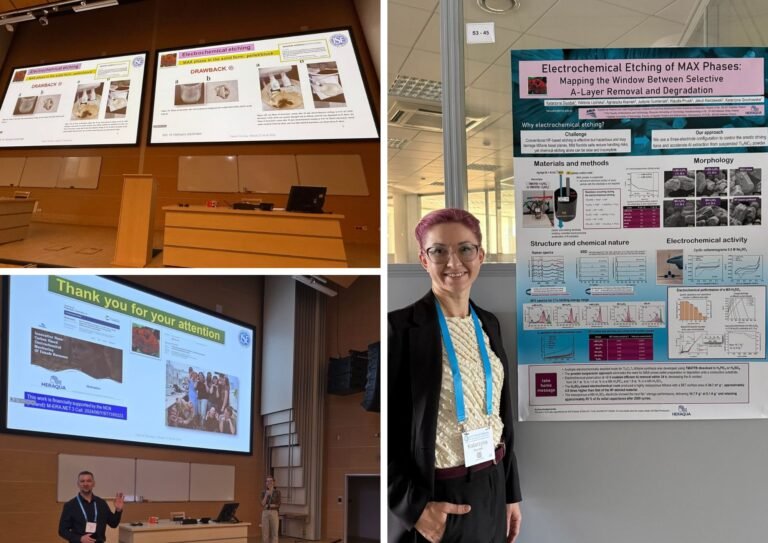
Katarzyna Siuzdak presented HERAqua-related research during both the poster and oral sessions. Her presentation, entitled “Controlling the MAX-to-MXene Transition: The Role of Electrochemical Etching”, addressed electrochemical routes for the conversion of MAX phases into MXenes. The work highlights the potential of controllable, HF-free synthesis strategies, while also identifying important challenges associated with etching selectivity, oxidation, defect formation and the reproducibility of the resulting materials.
The project’s research was also presented by Michalina Bonalska, PhD student involved in M.ERA-NET realization, in poster S3-27: “Citric Acid-Assisted Electrochemical Etching of Ti₃C₂Tₓ MXene”. Her contribution focused on the use of citric acid in electrochemical etching as a route towards the more sustainable preparation of MXene materials.
Beatriz Fernandes, a PhD student supervised by Prof. Rafael Bouro, also delivered an excellent poster presentation entitled “Single-Step Electropolymerisation of a Poly(Toluidine Blue)/Graphene Quantum Dot Nanocomposite in Binary and Ternary Natural Deep Eutectic Solvents for Nitrite Sensing.”
Those contributions were supported by the HERAqua project and created valuable opportunities to discuss recent results with the international electrochemistry community, exchange ideas, and collect feedback that will support the further development of MXene-based materials and sensing platforms. The conference programme included dedicated sessions on electrochemical interfaces, materials and architectures, as well as smart electrochemical systems for health, safety and food applications – areas closely aligned with HERAqua’s research objectives.
27-30/09/ 2026
HERAqua research presented at the 43rd ISE Topical Meeting in Gdańsk
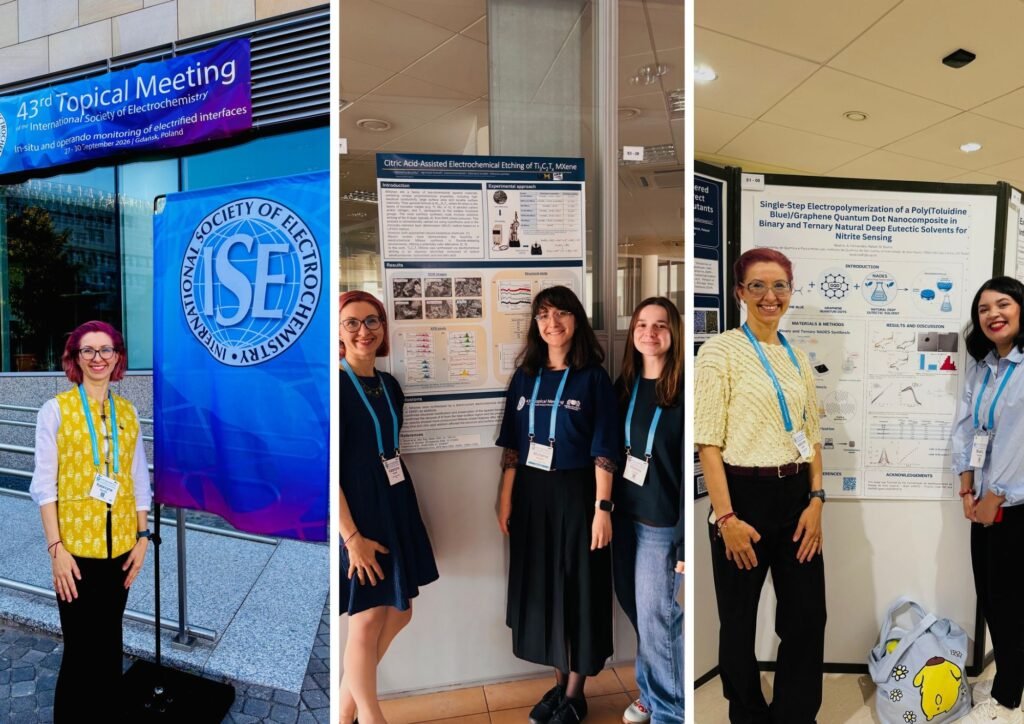
The HERAqua project was represented at the 43rd Topical Meeting of the International Society of Electrochemistry, held in Gdańsk, Poland, on 27–30 September 2026. The meeting, dedicated to In-situ and Operando Monitoring of Electrified Interfaces, brought together researchers working on electrochemical interfaces, functional materials, sensors and advanced characterisation methods.
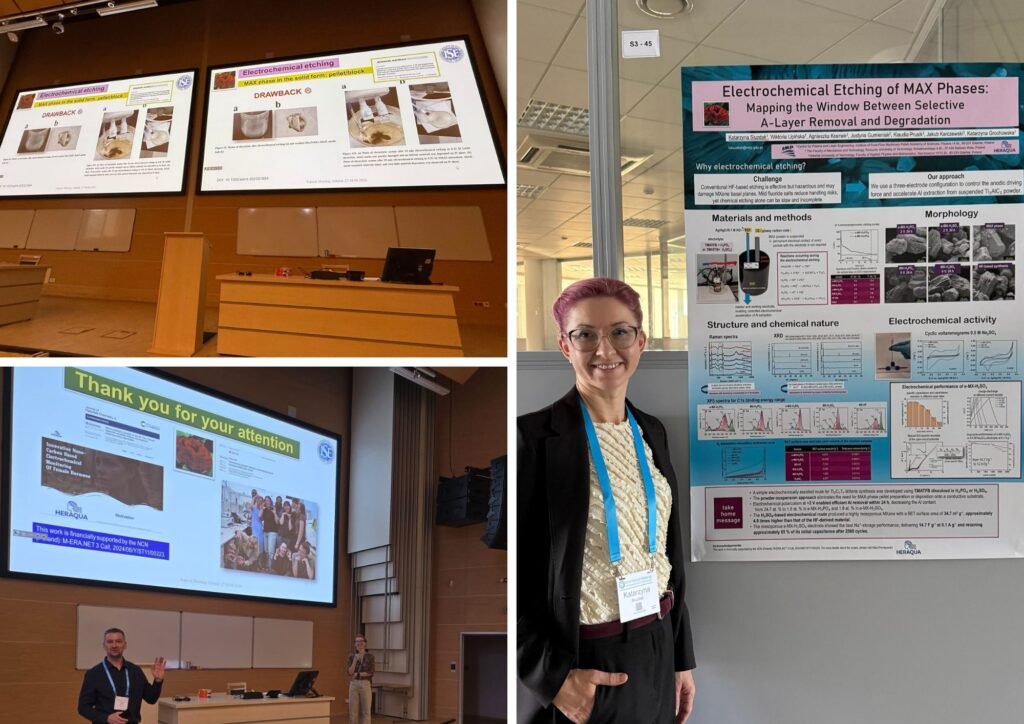
Katarzyna Siuzdak presented HERAqua-related research during both the poster and oral sessions. Her presentation, entitled “Controlling the MAX-to-MXene Transition: The Role of Electrochemical Etching”, addressed electrochemical routes for the conversion of MAX phases into MXenes. The work highlights the potential of controllable, HF-free synthesis strategies, while also identifying important challenges associated with etching selectivity, oxidation, defect formation and the reproducibility of the resulting materials.
The project’s research was also presented by Michalina Bonalska, PhD student involved in M.ERA-NET realization, in poster S3-27: “Citric Acid-Assisted Electrochemical Etching of Ti₃C₂Tₓ MXene”. Her contribution focused on the use of citric acid in electrochemical etching as a route towards the more sustainable preparation of MXene materials.
Beatriz Fernandes, a PhD student supervised by Prof. Rafael Bouro, also delivered an excellent poster presentation entitled “Single-Step Electropolymerisation of a Poly(Toluidine Blue)/Graphene Quantum Dot Nanocomposite in Binary and Ternary Natural Deep Eutectic Solvents for Nitrite Sensing.”
Those contributions were supported by the HERAqua project and created valuable opportunities to discuss recent results with the international electrochemistry community, exchange ideas, and collect feedback that will support the further development of MXene-based materials and sensing platforms. The conference programme included dedicated sessions on electrochemical interfaces, materials and architectures, as well as smart electrochemical systems for health, safety and food applications – areas closely aligned with HERAqua’s research objectives.
14/09/2026
4th HerAqua M.ERA-NET online meeting: Progress Review and Technical Advancements Across Work Packages
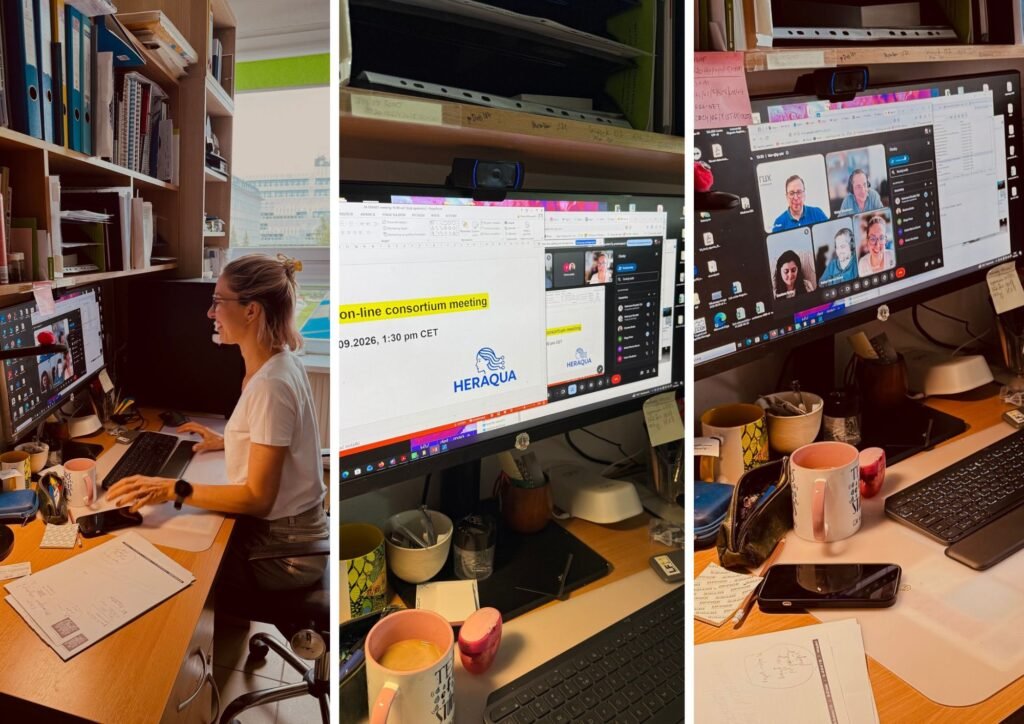
On 14 September 2026, the HERAqua consortium held its fourth online meeting to review recent progress and coordinate the next stages of work on advanced MXene-based materials and electrochemical sensing platforms. Partners discussed ongoing manuscript preparation, the development of MXene-modified screen-printed electrodes, and the integration of microfluidic systems for future sensing applications.
A key part of the meeting focused on the electrochemically assisted fabrication of MXenes, their characterisation, and chemical modification with gold. The consortium also discussed the use of titania nanotubes, graphene quantum dots and biorecognition elements, including antibodies, to develop highly selective and sensitive sensing-electrode materials.
In the coming months, the partners will focus on optimising MXene functionalisation, fabricating carbon-ink electrodes modified with MXene, developing materials containing magnetic nanoparticles, and advancing the preparation and submission of several scientific publications. The consortium also plans to meet in person during the upcoming European Biosensor Symposium in Cluj-Napoca, strengthening collaboration across the HERAqua.
14/09/2026
4th HerAqua M.ERA-NET online meeting: Progress Review and Technical Advancements Across Work Packages
On 14 September 2026, the HERAqua consortium held its fourth online meeting to review recent progress and coordinate the next stages of work on advanced MXene-based materials and electrochemical sensing platforms. Partners discussed ongoing manuscript preparation, the development of MXene-modified screen-printed electrodes, and the integration of microfluidic systems for future sensing applications.
A key part of the meeting focused on the electrochemically assisted fabrication of MXenes, their characterisation, and chemical modification with gold. The consortium also discussed the use of titania nanotubes, graphene quantum dots and biorecognition elements, including antibodies, to develop highly selective and sensitive sensing-electrode materials.
In the coming months, the partners will focus on optimising MXene functionalisation, fabricating carbon-ink electrodes modified with MXene, developing materials containing magnetic nanoparticles, and advancing the preparation and submission of several scientific publications. The consortium also plans to meet in person during the upcoming European Biosensor Symposium in Cluj-Napoca, strengthening collaboration across the HERAqu
6-11/09/2026
Activity at EEE International Conference “Nanomaterials: Applications & Properties”
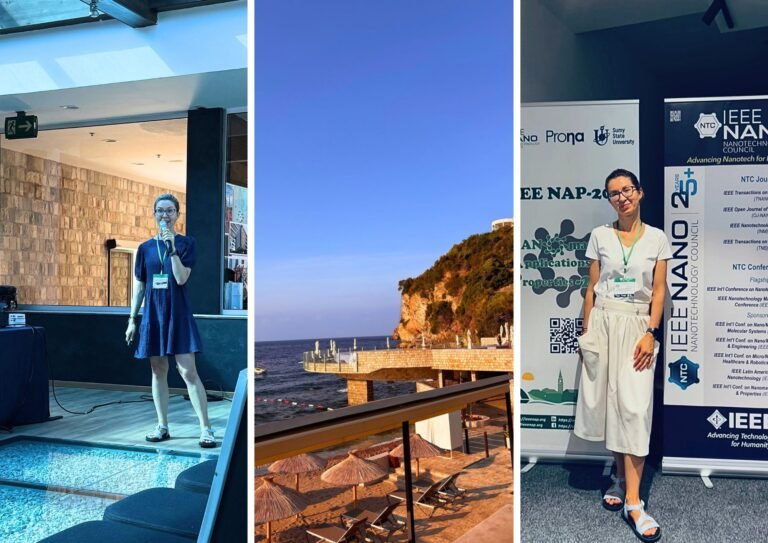
Katarzyna Siuzdak took part in the IEEE International Conference “Nanomaterials: Applications & Properties” and had the opportunity for oral presentation of the recent work entitled:
“Glassy-Carbon-Assisted Electrochemical Etching of MAX Phases: Control, Limitations, and Opportunities.”
During her presentation, she introduced a three-electrode electrochemical approach, supported by a glassy-carbon electrode, for the HF-free etching of MAX phases towards MXene synthesis. This strategy offers a potentially safer alternative to conventional chemical etching, while providing better control over the electrochemical driving force. It also enables the systematic investigation of the influence of key parameters, including the applied potential, etching time, and electrolyte composition.
Her results also highlighted several challenges that still require further optimisation, particularly defect formation, local over-oxidation, and the need to define an appropriate etching window to ensure the reproducible synthesis of high-quality MXenes.
Beyond the excellent scientific programme, the conference is taking place in a truly beautiful setting. Budva has welcomed the participants with sunny weather, spectacular views, and a wonderfully warm Adriatic Sea, offering a perfect opportunity to recharge between scientific sessions.
6-11/09/2026
Activity at EEE International Conference “Nanomaterials: Applications & Properties”
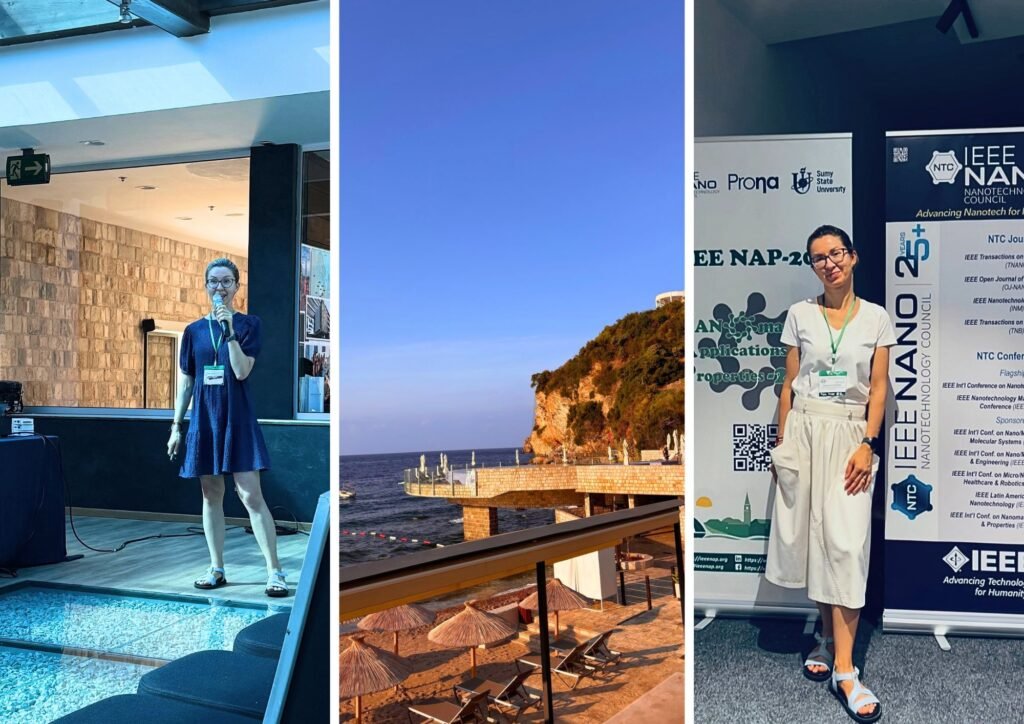
Katarzyna Siuzdak took part in the IEEE International Conference “Nanomaterials: Applications & Properties” and had the opportunity for oral presentation of the recent work entitled:
“Glassy-Carbon-Assisted Electrochemical Etching of MAX Phases: Control, Limitations, and Opportunities.”
During her presentation, she introduced a three-electrode electrochemical approach, supported by a glassy-carbon electrode, for the HF-free etching of MAX phases towards MXene synthesis. This strategy offers a potentially safer alternative to conventional chemical etching, while providing better control over the electrochemical driving force. It also enables the systematic investigation of the influence of key parameters, including the applied potential, etching time, and electrolyte composition.
Her results also highlighted several challenges that still require further optimisation, particularly defect formation, local over-oxidation, and the need to define an appropriate etching window to ensure the reproducible synthesis of high-quality MXenes.
Beyond the excellent scientific programme, the conference is taking place in a truly beautiful setting. Budva has welcomed the participants with sunny weather, spectacular views, and a wonderfully warm Adriatic Sea, offering a perfect opportunity to recharge between scientific sessions.
8/06/2026
Participation in NanoTech Poland 2026 Conference
Katarzyna Siuzdak had the pleasure of participating in NanoTech Poland 2026, an international conference organized by the NanoBioMedical Centre and Adam Mickiewicz University, held on 8–11 June 2026, which brings together researchers working at the forefront of nanoscience and nanotechnology.
The event provided an excellent platform for exchanging ideas across disciplines, from materials science to advanced energy applications.
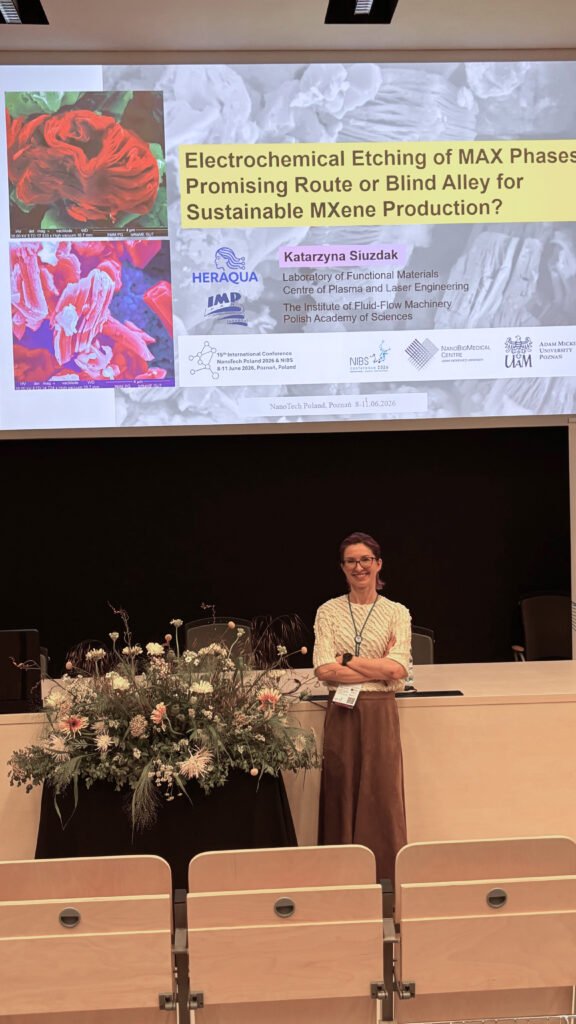
Katarzyna was honored to give an invited lecture entitled:
“Electrochemical Etching of MAX Phases: Promising Route or Blind Alley for Sustainable MXene Production?”,
which presented an in-depth analysis of the current state of the art in electrochemical MXene formation, enriched by results obtained within the HerAqua project. In particular, she discussed the morphology and structure of MXenes fabricated using a glassy carbon crucible serving simultaneously as the reactor and the working electrode.
8/06/2026
Participation in NanoTech Poland 2026 Conference
Katarzyna Siuzdak had the pleasure of participating in NanoTech Poland 2026, an international conference organized by the NanoBioMedical Centre and Adam Mickiewicz University, held on 8–11 June 2026, which brings together researchers working at the forefront of nanoscience and nanotechnology.
The event provided an excellent platform for exchanging ideas across disciplines, from materials science to advanced energy applications.
Katarzyna was honored to give an invited lecture entitled:
“Electrochemical Etching of MAX Phases: Promising Route or Blind Alley for Sustainable MXene Production?”,
which presented an in-depth analysis of the current state of the art in electrochemical MXene formation, enriched by results obtained within the HerAqua project. In particular, she discussed the morphology and structure of MXenes fabricated using a glassy carbon crucible serving simultaneously as the reactor and the working electrode.
5/05/2026
HerAqua partners held the third M.ERA-NET on-line consortium meeting on 5 May to review progress and plan the next steps across work packages.
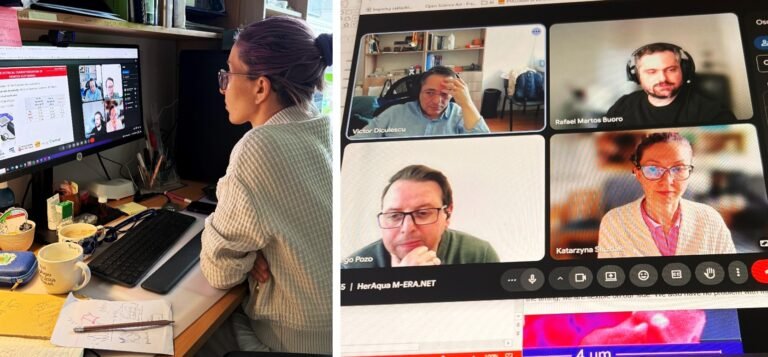
The meeting was attended by Victor Diculescu, Rafael Buoro, Diego F. Pozo Ayuso, and Katarzyna Siuzdak.
On the microfluidics side, the team led by Victor Diculescu demonstrated how different chip configurations influence fluid mixing in the main chamber, where electrochemical measurements will be performed.The presented simulation clearly shows the flow of the fluid depending on changes in the channel geometry.
Rafael Buoro presented results described in two nearly completed manuscripts. The first study investigates graphene quantum dots (GQDs) as modifiers for poly(neutral red) (PNR)/GQD nanocomposite electrochemical sensors fabricated on glassy carbon electrodes in natural deep eutectic solvents (NADES). Under optimized conditions, the modified electrodes enabled sensitive determination of sulfanilamide using differential pulse voltammetry, showing a broader working range and approximately tenfold higher sensitivity compared to bare electrodes. The second study focuses on GQDs synthesized from glucose and dispersed in the NADES reline, used as a partial substitute for mineral oil in carbon paste electrodes for paracetamol detection.
Diego F. Pozo Ayuso presented results on the incorporation of MXenes, provided by the Katarzyna Siuzdak group, into Micrux carbon ink. Electrochemical tests demonstrated that MXene additives enhance electrochemical activity in the presence of a redox probe.
Katarzyna Siuzdak shows progress on the electrochemical etching of MAX phases. One approach is based on tetramethylammonium tetrafluoroborate in an acidic environment, leading to MXene formation with low alumina content (approximately 1%). A second approach employs NaBF4 as the etching agent, with optimization of time, concentration, and electrolyte composition to achieve efficient MXene synthesis.
The consortium also discussed optimal strategies for gold modification of MXenes, their use as additives in carbon inks for screen-printed electrodes, and MXene integration with magnetic nanoparticles.
The next online meeting is planned for the second week of July.
5/05/2026
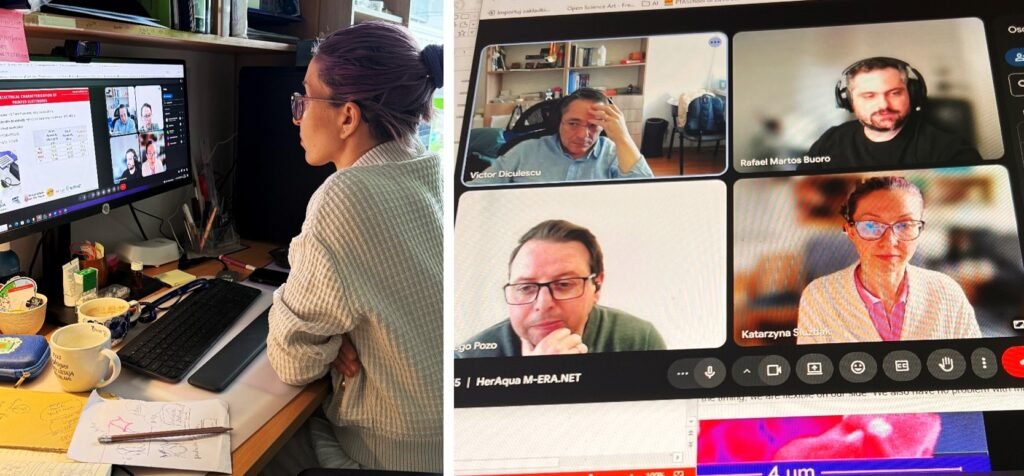
HerAqua partners held the third M.ERA-NET on-line consortium meeting on 5 May to review progress and plan the next steps across work packages.
The meeting was attended by Victor Diculescu, Rafael Buoro, Diego F. Pozo Ayuso, and Katarzyna Siuzdak.
On the microfluidics side, the team led by Victor Diculescu demonstrated how different chip configurations influence fluid mixing in the main chamber, where electrochemical measurements will be performed.The presented simulation clearly shows the flow of the fluid depending on changes in the channel geometry.
Rafael Buoro presented results described in two nearly completed manuscripts. The first study investigates graphene quantum dots (GQDs) as modifiers for poly(neutral red) (PNR)/GQD nanocomposite electrochemical sensors fabricated on glassy carbon electrodes in natural deep eutectic solvents (NADES). Under optimized conditions, the modified electrodes enabled sensitive determination of sulfanilamide using differential pulse voltammetry, showing a broader working range and approximately tenfold higher sensitivity compared to bare electrodes. The second study focuses on GQDs synthesized from glucose and dispersed in the NADES reline, used as a partial substitute for mineral oil in carbon paste electrodes for paracetamol detection.
Diego F. Pozo Ayuso presented results on the incorporation of MXenes, provided by the Katarzyna Siuzdak group, into Micrux carbon ink. Electrochemical tests demonstrated that MXene additives enhance electrochemical activity in the presence of a redox probe.
Katarzyna Siuzdak shows progress on the electrochemical etching of MAX phases. One approach is based on tetramethylammonium tetrafluoroborate in an acidic environment, leading to MXene formation with low alumina content (approximately 1%). A second approach employs NaBF4 as the etching agent, with optimization of time, concentration, and electrolyte composition to achieve efficient MXene synthesis.
The consortium also discussed optimal strategies for gold modification of MXenes, their use as additives in carbon inks for screen-printed electrodes, and MXene integration with magnetic nanoparticles.
The next online meeting is planned for the second week of July.
27/01/2026
HerAqua Second M.ERA-NET Meeting: Progress Review and Technical Advancements Across Work Packages
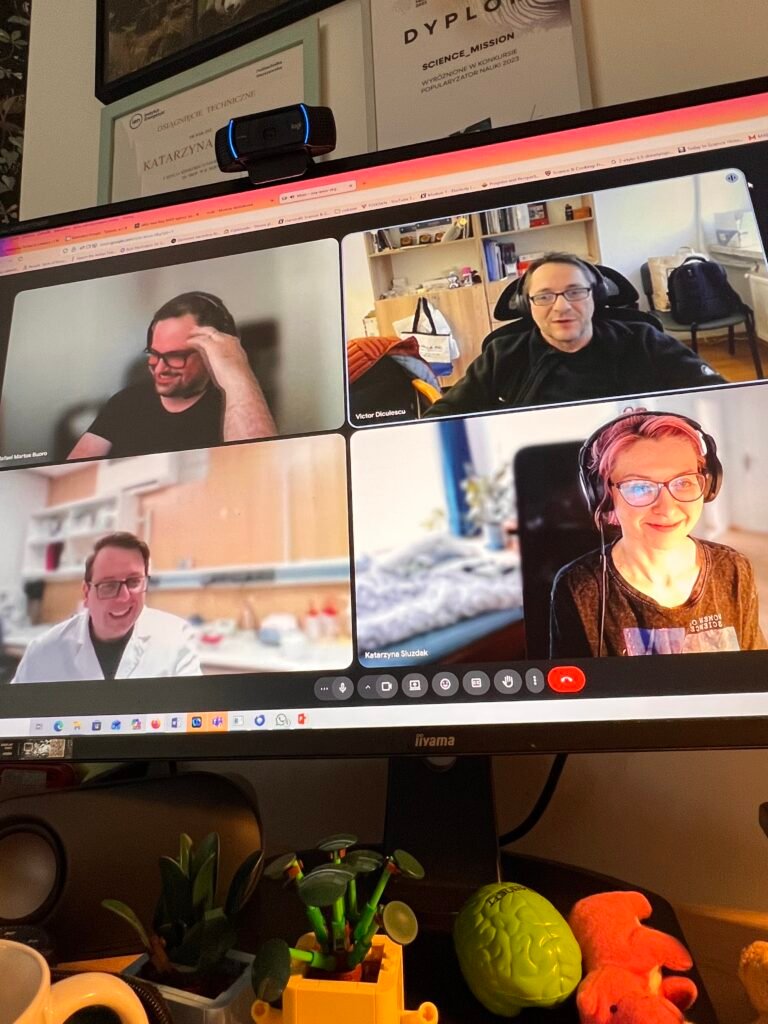
On 27 January, HerAqua consortium members convened online for the second M.ERA-NET meeting to assess initial progress and coordinate forthcoming activities across the work packages. The meeting was attended by Victor Diculescu, Rafael Buoro, Diego F. Pozo Ayuso, and Katarzyna Siuzdak.
The team led by Victor Diculescu reported the establishment of a calibrated 3D-printing workflow, the definition of microchannel design tolerances, and the application of numerical simulations to identify electrode geometries ensuring stable hydrodynamic and electrochemical performance.
Within WP2, Rafael Buoro presented sustainable synthesis routes for graphene quantum dots (GQDs) prepared from citric acid and glucose using natural deep eutectic solvents. When incorporated into conductive matrices, these GQDs demonstrated improved electroactive surface area and charge-transfer efficiency.
At IMP PAN, ongoing efforts focus on the optimization of fluoride-free electrochemical synthesis of MXenes from MAX phases. Although full delamination into separate layers remains challenging, progress continues under the supervision of Katarzyna Siuzdak.
Moving forward, partners will refine GQD-based electrode formulations, continue MXene ink development under the guidance of Diego F. Pozo Ayuso, advance microfluidic device design, and maintain coordinated dissemination through the project website, LinkedIn, and upcoming conferences.
27/01/2025
HerAqua Second M.ERA-NET Meeting: Progress Review and Technical Advancements Across Work Packages
On 27 February, HerAqua consortium members convened online for the second M.ERA-NET meeting to assess initial progress and coordinate forthcoming activities across the work packages. The meeting was attended by Victor Diculescu, Rafael Buoro, Diego F. Pozo Ayuso, and Katarzyna Siuzdak.
The team led by Victor Diculescu reported the establishment of a calibrated 3D-printing workflow, the definition of microchannel design tolerances, and the application of numerical simulations to identify electrode geometries ensuring stable hydrodynamic and electrochemical performance.
Within WP2, Rafael Buoro presented sustainable synthesis routes for graphene quantum dots (GQDs) prepared from citric acid and glucose using natural deep eutectic solvents. When incorporated into conductive matrices, these GQDs demonstrated improved electroactive surface area and charge-transfer efficiency.
At IMP PAN, ongoing efforts focus on the optimization of fluoride-free electrochemical synthesis of MXenes from MAX phases. Although full delamination into separate layers remains challenging, progress continues under the supervision of Katarzyna Siuzdak.
Moving forward, partners will refine GQD-based electrode formulations, continue MXene ink development under the guidance of Diego F. Pozo Ayuso, advance microfluidic device design, and maintain coordinated dissemination through the project website, LinkedIn, and upcoming conferences.
23.09.2025
Kick-off meeting
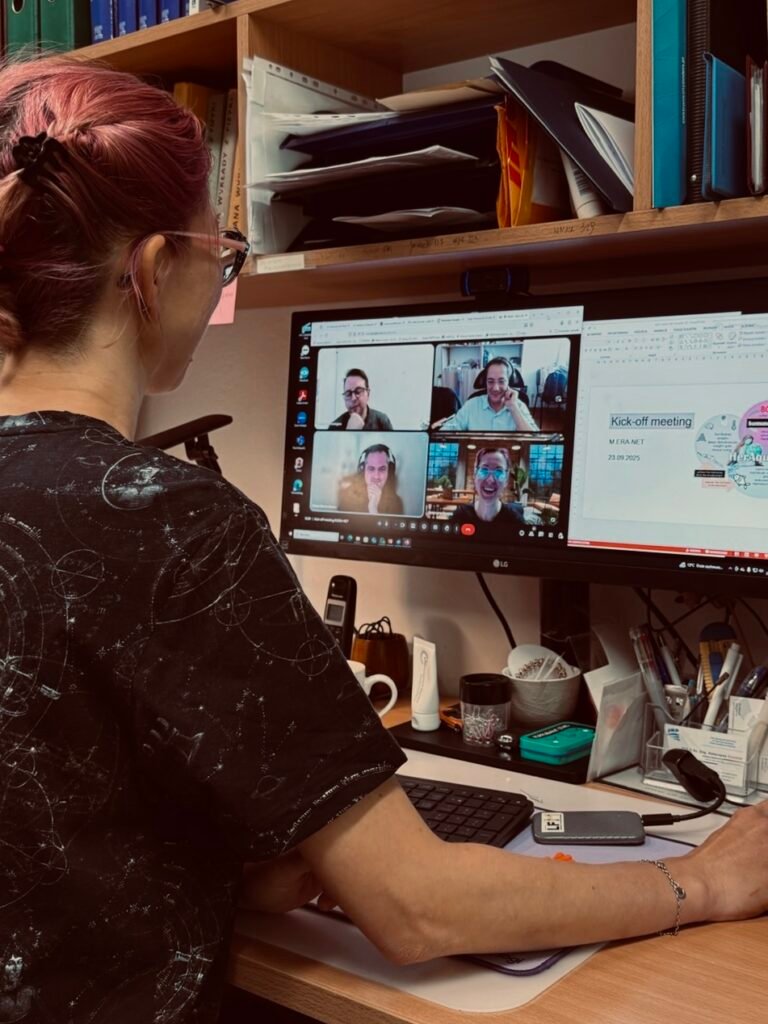
The HerAqua project consortium held its online kick-off meeting on-line, bringing together all partner institutions. During the meeting, team members introduced their organizations and outlined the main objectives and activities of the project.
All partners discussed initial plans, emphasized collaboration, and agreed on key milestones for the upcoming months.
The event also highlighted the importance of effective communication and dissemination of project news.
The next online meeting is scheduled in three months’ time.
23.09.2025
Kick-off meeting
The HerAqua project consortium held its online kick-off meeting on-line, bringing together all partner institutions. During the meeting, team members introduced their organizations and outlined the main objectives and activities of the project.
All partners discussed initial plans, emphasized collaboration, and agreed on key milestones for the upcoming months.
The event also highlighted the importance of effective communication and dissemination of project news.
The next online meeting is scheduled in three months’ time.
1/09/2025
Project Launch: HERAqua Begins!
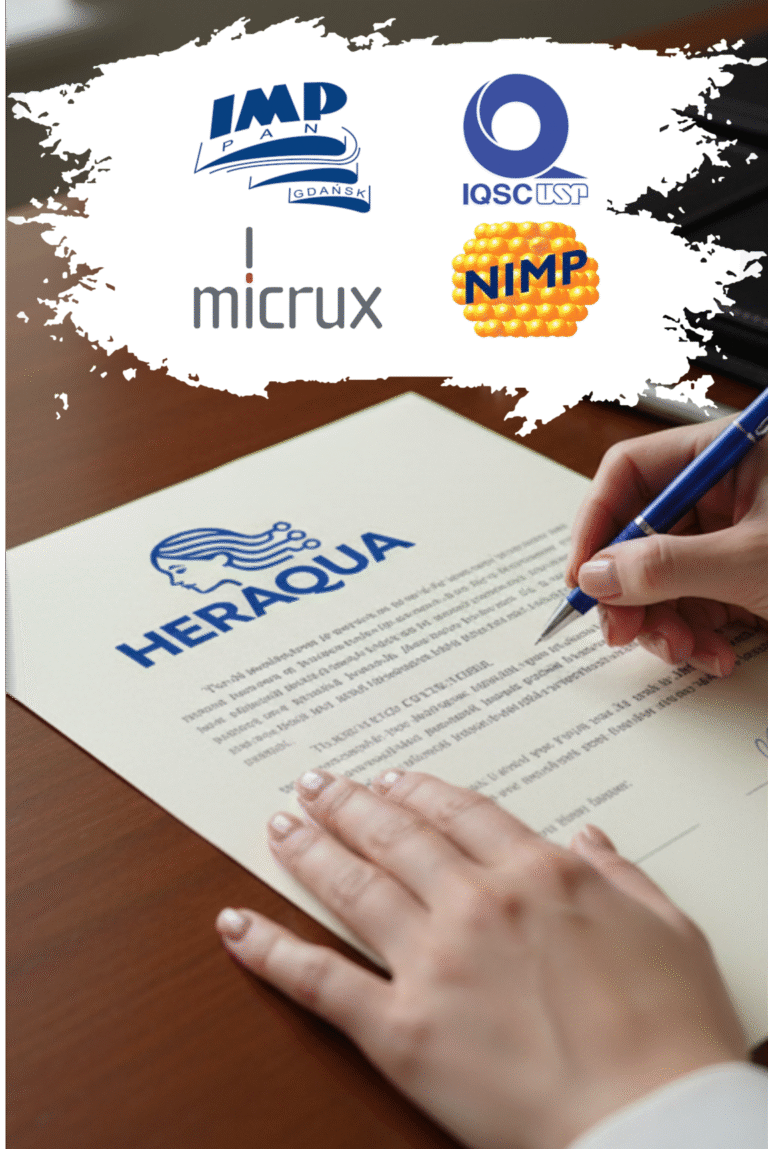
We are delighted to announce the official start of the HERAqua project, following the contract signing (agreement no. UMO-2024/06/Y/ST11/00223) with the National Science Centre of Poland
International consortium bringing together teams from Poland, Brazil, Spain, and Romania, we are embarking on an exciting scientific journey to develop next-generation solutions for hormone monitoring dedicated for human body fluids and water samples. According to the agreement, implementation starts on 1 September 2025 and we have 36 months to fulfill our goals.
HERAqua aims to create an innovative, eco-friendly microfluidic device utilizing advanced nanocarbon-based electrochemical sensors to address the critical issue of hormone contamination and contribute to both human health and environmental protection.
We believe that the strong collaboration within our global consortium will allow us to achieve all our goals and make a positive impact for science and society.
Let’s begin this shared adventure – stay tuned for more updates and milestones!
1/09/2025
Project Launch: HERAqua Begins!
We are delighted to announce the official start of the HERAqua project, following the contract signing (agreement no. UMO-2024/06/Y/ST11/00223) with the National Science Centre of Poland
International consortium bringing together teams from Poland, Brazil, Spain, and Romania, we are embarking on an exciting scientific journey to develop next-generation solutions for hormone monitoring dedicated for human body fluids and water samples. According to the agreement, implementation starts on 1 September 2025 and we have 36 months to fulfill our goals.
HERAqua aims to create an innovative, eco-friendly microfluidic device utilizing advanced nanocarbon-based electrochemical sensors to address the critical issue of hormone contamination and contribute to both human health and environmental protection.
We believe that the strong collaboration within our global consortium will allow us to achieve all our goals and make a positive impact for science and society.
Let’s begin this shared adventure – stay tuned for more updates and milestones!