Project

scott graham 5fnmwej4taa unsplash

The scope of HerAqua

is to develop a microfluidic (bio)sensing device for the continuous monitoring of different hormones in aqueous media, such as samples of synthetic human body fluids and environmental waters.

scott graham 5fnmwej4taa unsplash

The scope of HerAqua

is to develop a microfluidic (bio)sensing device for the continuous monitoring of different hormones in aqueous media, such as samples of synthetic human body fluids and environmental waters.

scott graham 5fnmwej4taa unsplash

The scope of HerAqua

is to develop a microfluidic (bio)sensing device for the continuous monitoring of different hormones in aqueous media, such as samples of synthetic human body fluids and environmental waters.

In order to achieve the scope of HerAqua 3 objectives are settled:
  • Development of carbon nanomaterials-based screen printed electrodes MXenes.
  • Development of (bio)sensors for the detection of hormones in artificial body fluids and residual waters.
  • Development of a micro fluidic device integrated (bio)sensors for continuous monitoring of hormones in artificial body fluids and residual waters.
tekst akapitu (3)
  • Development of carbon nanomaterials-based screen printed electrodes MXenes.
  • Development of (bio)sensors for the detection of hormones in artificial body fluids and residual waters.
  • Development of a micro fluidic device integrated (bio)sensors for continuous monitoring of hormones in artificial body fluids and residual waters.
tekst akapitu (3)
  • Development of carbon nanomaterials-based screen printed electrodes MXenes.
  • Development of (bio)sensors for the detection of hormones in artificial body fluids and residual waters.
  • Development of a micro fluidic device integrated (bio)sensors for continuous monitoring of hormones in artificial body fluids and residual waters.
tekst akapitu (3)
tekst akapitu (3)

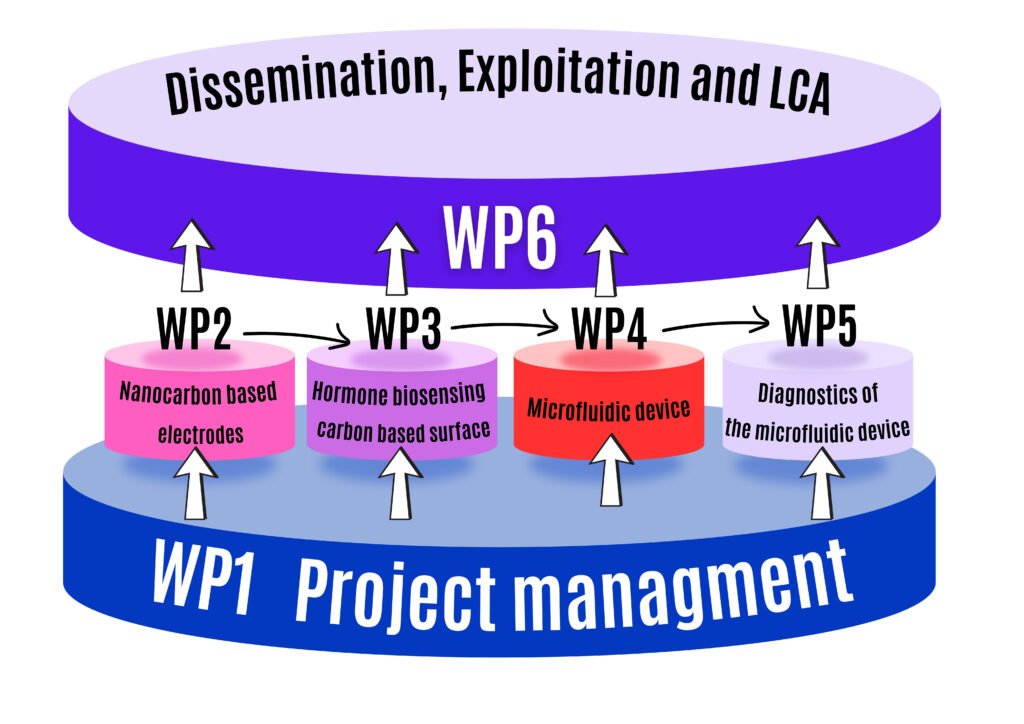
The work plan of HerAqua project consists of six interconnected Work Packages (WP)

tekst akapitu (3)

The work plan of HerAqua project consists of six interconnected Work Packages (WP)

WP1 (led by IMP PAN) focusing on coordinating and monitoring all activities and milestones.

WP2 (led by IQSC) involves developing eco-friendly synthesis methods of nanocarbon based electrodes.

WP3 (led by IMP PAN) focuses on creating biosensors tailored for hormone detection.

WP4 (led by MICRUX) handles the design and integration of the microfluidic device.

WP5 (led by NIMP) is dedicated to testing and characterising the integrated device, ensuring functionality across different sample types.

WP6 (led by IMP PAN) addresses dissemination, exploitation, and lifecycle analysis to support the project’s commercialization.

Each WP is divided into tasks, where particular actions (e.g. synthesis procedure, complex characterisation of obtained materials and electrodes, fabrication of the prototypes, tests carried out in various conditions) are described and risk analysis with contingency strategies are provided.